

What is Black Death?
Black Death
The subject of system flushing would not be complete without discussing Black Death. This is a topic which first appeared on the AC Source web site. This article was written by Warren Willingham, and has been reprinted here with permission.
What is Black Death?
Black Death is the worst compressor disease to hit our industry since the DA6 came out and was spitting ring material through the system! At least the DA6 Teflon "droppings" were something that could be flushed out easily. Back then, they didn't use multi pass, or parallel flow condensers. The old tube and fin condenser, although not as efficient as the others I mentioned, could be flushed with excellent results.
After we became familiar with the DA6, then comes the FX15 compressor. The Teflon rings of the FX15 get munched into a fine dust. At least when the DA6 compressor shed it's rings it did it in chunks. Well, now you mix this powdered Teflon (courtesy of the FX15) with a nice hot oil and refrigerant and there you have it. Black death! It's an ugly sight to behold, especially when you know what it means to your customer's pocket book! What's so bad about this type of contamination, you might ask? We'll attempt to explain that in the following paragraphs.
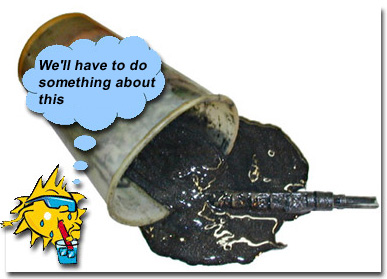
The material, known as black death, is unlike normal contamination. As the system cools down, this crud bonds itself to the components in the system. Normal flushing appears to be cleaning out the system because you see some of the contamination come out with the flush. The biggest problem is that most of it is still inside, almost like a powder coating on a piece of metal. Because you see what looks like the contamination coming out in the flush, you assume that the system is clean. OOPS, it's that old assume word again. It's not!
A regular flush gun, attached to your air compressor with even the best liquid flush, is not powerful enough to remove the Black Death material from components in most cases. Even a closed loop flush machine isn't enough sometimes. We'll tell you what Ford dealerships had to do about the problem.
Ford Motor Co. required all of their dealers to purchase the "Rotunda" flush machine. The machine was manufactured by the Cliplight Corporation. They also made a flush that was powerfull (caustic) enough to actually break this contamination down into a flushable material. My friends at a Ford dealership when this first started told me that they had to do these systems outside because the smell was overwhelming. With this method, the dealerships seemed to be successful in flushing these systems.
Early on, we would recommend filters in the suction and discharge side to protect the orifice tube and the compressor. This didn't always work because the contamination was so severe, it would just plug up the filters in a very short amount of time. That's a lot of contamination. Ford did have a succesfull filter procedure, but it was actually labor intensive enough to justify changing components instead of doing the filter procedure! It was O.K. for Ford, but typical shops couldn't afford to waste an extra two hours with charge, recover, recharge, recover, recharge, etc.! To make a long story short, filters were not very efficient for us.
What was the best thing to do then? Well, it came down to a firewall forward replacement. Because this was so prevalent, manufacturers lowered pricing on these parts so that you could buy the whole firewall forward kit for what a compressor and accumulator cost years ago. Everything except the evaporator core was replaced. It was the only answer in a high percentage of Black Death cases unless you had the same equipment Ford did. Oh, BTW, it was about $2500 for the machine alone (I haven't priced it for awhile) and $45 for a gallon of flush. Each job required at least one gallon.
I'm not always popular for telling the truth. The fact is, many people doing these jobs shouldn't be. They don't accept that some systems can't be flushed and if they did replace everything they didn't always finish the job. They would replace all of the components and leave the defective fan clutch that caused the meltdown to begin with. These systems are more than the compressor and accumulator. Fan clutches, electric fans, radiators, etc, are not what people consider part of the A/C system but are responsible for many of the breakdowns and lockups, in my opinion.
Stay Cool!
Warren Willingham
Add a Comment